
Attraction
Amsa-dong Prehistoric Site, Seoul
Gangdong
Korean name서울 암사동 유적
875 Olympic-ro, Gangdong-gu, Seoul (Amsa-dong)
Place story
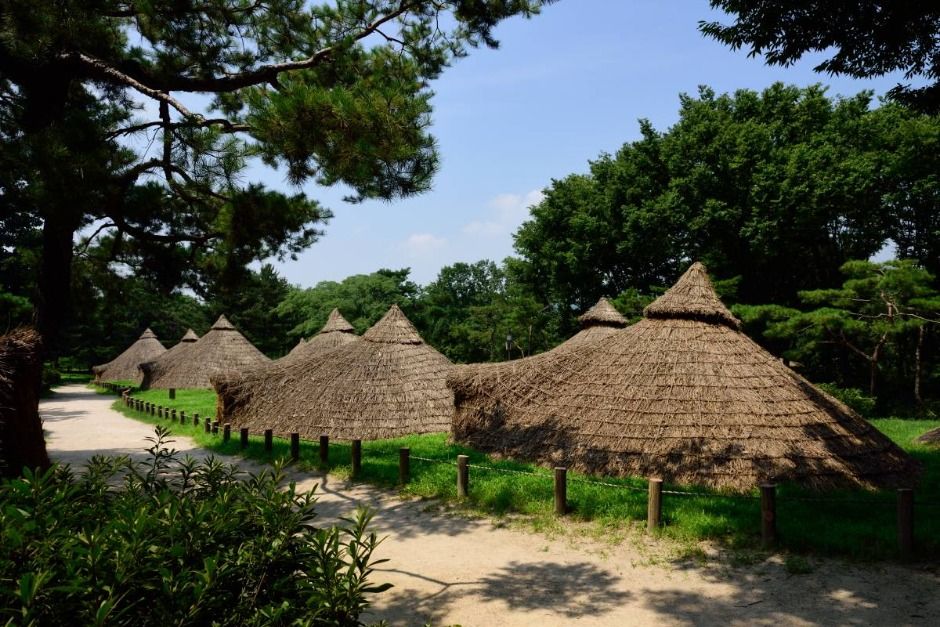
Amsa-dong is a Neolithic site on the Han River opposite Achasanseong Fortress and a representative site of Korean prehistory. Three cultural layers have been identified, and radiocarbon dating places the remains between 4000 and 3000 BCE. Repeated excavations uncovered more than 40 dwelling sites, associated facilities, and stone-pile features, preserving traces of people who lived by fishing and gathering around the Han River. The house floors were dug in circular or rounded-square shapes, about 5–6 m long and 70–100 cm deep. Stone-ringed hearths are visible in the centers, and entrances generally face south. There are usually four postholes, suggesting that posts at the corners supported a roof. Numerous pointed-bottom comb-pattern pottery vessels were found, along with stone axes, net sinkers, and charred acorns. Amsa-dong is an important Neolithic site of the Han River basin and is described in the source as the largest village-scale Neolithic settlement identified in Korea. Its many excavated objects provide evidence of everyday life at the time.
Read the Korean source description
우리나라 선사시대를 대표하는 서울 암사동 유적은 아차산성을 마주하는 한강변에 있는 신석기시대 유적이다. 3개의 문화층이 확인되었고, 방사선탄소측정에 따르면 BC 4,000~3,000년기에 걸친 유적이다. 여러 차례 발굴조사 결과 40기 이상의 집터와 딸린시설, 돌무지시설이 발견되었다. 한강을 중심으로 어로와 채집 생활을 하며 살았던 신석기시대 사람들 삶의 흔적이 고스란히 남아있다. 집터는 바닥을 둥글거나 모서리를 죽인 네모꼴로 팠으며, 크기는 길이 5~6m, 깊이 70~100㎝ 정도이다. 집터 가운데에 돌을 두른 화덕자리도 보이며, 입구는 주로 남쪽을 향한다. 기둥구멍은 보통 4개이며, 모서리에 기둥을 세우고 지붕을 만든 것으로 보인다. 또한 바닥이 뾰족한 빗살무늬 토기가 많이 나왔으며, 돌도끼, 그물추, 불에 탄 도토리 등도 출토되었다.서울 암사동 유적은 한강유역의 대표적인 신석기시대 유적이며, 지금까지 확인된 우리나라 신석기시대 유적 중 최대의 마을단위 유적으로서 매우 중요하다. 또한 당시 생활모습을 살필 수 있는 유물이 많이 출토되었다.
Source content updated: